Showing posts with label gazania. Show all posts

Spring in the Desert

4/8/12

backyard  view from house
     While I was gone for my visit to Virginia, my garden and yard burst into bloom.  The middle of March to the middle of April is the best time of the year here.  This is the time when the desert blooms, and the weather is the most pleasant, with temperatures running from the mid 70's to high 80's.

     This is the view out my kitchen window  into the backyard.  Let's walk through the garden and I will show you what's blossoming.


gazania

gazania

     I have several gazania of different colors.  Above are photos of two: a burnt-orange and white variety and a yellow-orange variety.

red rose


white rose

     My rose bushes are blooming away and have several blooms and buds.  I've been bringing fresh cut roses in the house.  Above are a red Mr. Lincoln rose and a white Honor rose.


marigold

strawflower


cosmos

ornamental cabbage

     My marigolds scattered throughout the garden have just started blooming, as well as the strawflowers and cosmos, but the ornamental cabbage has gone to seed.

red mum

     I bought this potted red mum at the grocery last fall.  I planted it in the yard after blooming, and it has buds so will soon bloom again.

blue cup

     My blue cup plants are the color standouts in the garden now.

view of half of the flower garden

     Next week I'll show you what's happening in the yard.

What Do We Mean By "Native"?

2/5/12
Palo Verde tree, native to southern Arizona
     I don't know any gardeners that have only native plants in their yards or gardens, although there are gardeners probably striving to grow only natives.  But defining what we mean by native is challenging.

     Many gardeners accept only indigenous plants as native.  Gray's Anatomy of Botany says that to be indigenous there must be scientific evidence that the species has inhabited an area for a great length of time, that it's an integral part of local, evolutionary relationships with other plants and animals.

Saguaro cactus, native to southern Arizona
     But what is a great length of time?  Thousands of years? Hundreds of years?  For example, there were plants that were present in an area of the globe before a glacial period, different plants that were present during a glacial period and different plants after a glacial period.  Can all be considered native?  When European colonists arrived in the Americas hundreds of years ago and introduced species that live on unassisted today, are these species considered native?  If a plant has  become naturalized as a member of the wild flora, needing no human assistance in self-perpetuating, can that plant then be called native?  What of an indigenous plant that migrates to a new area and becomes naturalized without assistance?  Is native a function of time and place?

Lantana, not native to southern Arizona
      Situations like this occur all over the world.  If native status is a function not only of time but also of place, defining place can be a perplexing.  There can be dramatic differences in habitat within a relatively small area.  In my own state of Arizona, within a twenty mile distance, you can go from desert habitat to tundra.  And the plants in the tundra habitat in Arizona are the same as the plants in the tundra of Alaska.

     And consider what we call invasive plants.  They would not exist unless they were better adapted to current conditions than so-called native species.  As Richard Darke says in the book The New American Landscape, " ...most natives are no more than earlier arrivals that established themselves because, at the time, they had a competitive advantage."

gazania, not native to southern Arizona

     Non-native plants fulfill roles that can't be accomplished by natives.  Many food plants grown in North American gardens do not have their origins here.  Many flowers that gardeners grow are not indigenous to their area, but provide beauty, fragrance, color and pleasure, such as the lantana and gazania pictured above that I grow in my yard.. 

     Most gardeners realize that no garden or landscape remains static, that local and global ecologies change.  In the end, I think most gardeners strive for balance among all their plants.

An Early Spring?

1/21/12

bulbs emerging early
     Many of the gardening blogs from all areas around the US have mentioned the warmer than normal temperatures.  We have experienced the same thing here in the desert.  The first week of January it was in the low 80's.  Normal is about 65 F (18 C) during the day.  The second week we were above normal too, but only in the low 70's.  We are finally back to normal this week with temperatures around 68 F (20 C).


petunias and pansies
     Many plants in the yard are showing the effects of the unseasonable warmth.  My bulbs are peeking up.  The petunias in the garden are flowering profusely. 

blue marguerite
     My blue marguerite  is blooming away.

gazania
     The gazania have all suddenly started flowering.


amaryllis two weeks ago

amaryllis one week ago


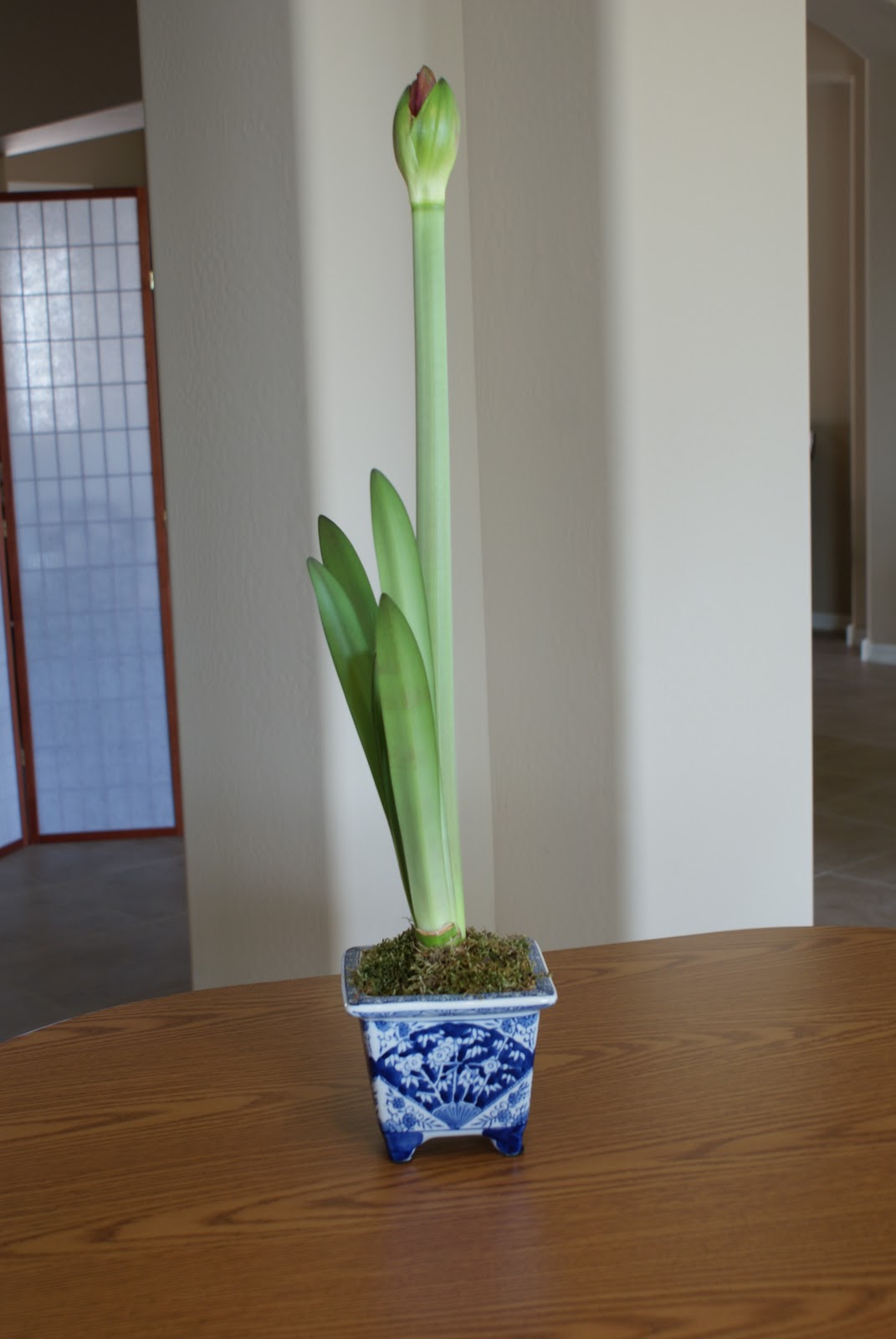
     Let's hope we don't have another freeze.  But for the last two years we had freezing weather the first week of February.  Oh, and the amaryllis I received as a Christmas gift from my brother and his wife is growing taller daily and will soon bloom.


amaryllis today


Two buds!


First Freeze

12/12/1
grapefruit tree
     We had three days in a row of below freezing temperatures this week for the first time this fall.  Last year the first freeze was in November.  I wrapped the orange, grapefruit and lime trees in sheets, and laid old sheets over the flower garden.

     Some plants did fine, others not so good.  I don't have enough old sheets and towels to cover everything that would benefit from covering.  I should invest in frost cloths, but I have such a large area to cover.  The citrus trees did fine.

frost damaged lantana
Some of the bougainvilleas do not look so good.  Last year most of the bougainvilleas were damaged, but I cut them back and all but three flowered again this year.  The leaves on some of the lantana turned brown and they will fall off.  When this happened last year, I lightly pruned them and almost all bloomed again this year.


     In the flower garden, some of the vinca and all of the cosmos are dead, but other plants did alright.  The blue maguerite is blooming away, as well as the gazania.

blue marguerite

gazania

The petunias are fine, and the pansies, of course, did not mind the cold weather.  The vegetable garden is done for the winter, except for the chard.  We had some with dinner yesterday.

rhubarb chard

Garden Changes


Blue Cup Plant
 4/18/11
     Over the last two weeks there have been many changes in my flower garden.  Probably because we have thirteen hours of daylight now, and the soil has finally warmed up.  My five blue cup flower plants are in full bloom.  Every inch of each plant is covered with violet blue flowers.   The strawflower and gazania plants are blanketed with blooms also.  I have never grown gazania before.  They seem to be self-sowing quite freely all over my garden.  As a matter of fact, they seem somewhat invasive. I thought I would try them as a cut flower.  They were not that good as a cut flower.  I had trouble getting the thick, white sticky sap off my hands.  You need just the right vase to accommodate them:  short with a wide opening at the neck.  They were finicky about opening in the house.   

Gazania
                                                        
 
Failing pansy
  There is decline in the garden also.  The 102 degree heat we had two weeks ago has taken a toll that has finally shown up.  The pansies are failing (one plant dead already).  The petunias are looking ragged especially in my patio pots.  It was 95 degrees the past two days, and that probably did not help either.  It is going to be in the upper 80's to 90 degrees most of the week, so I think the heat is here to stay.


Declining Petunia